
From Scan to Crown: Our Fully Digital Workflow
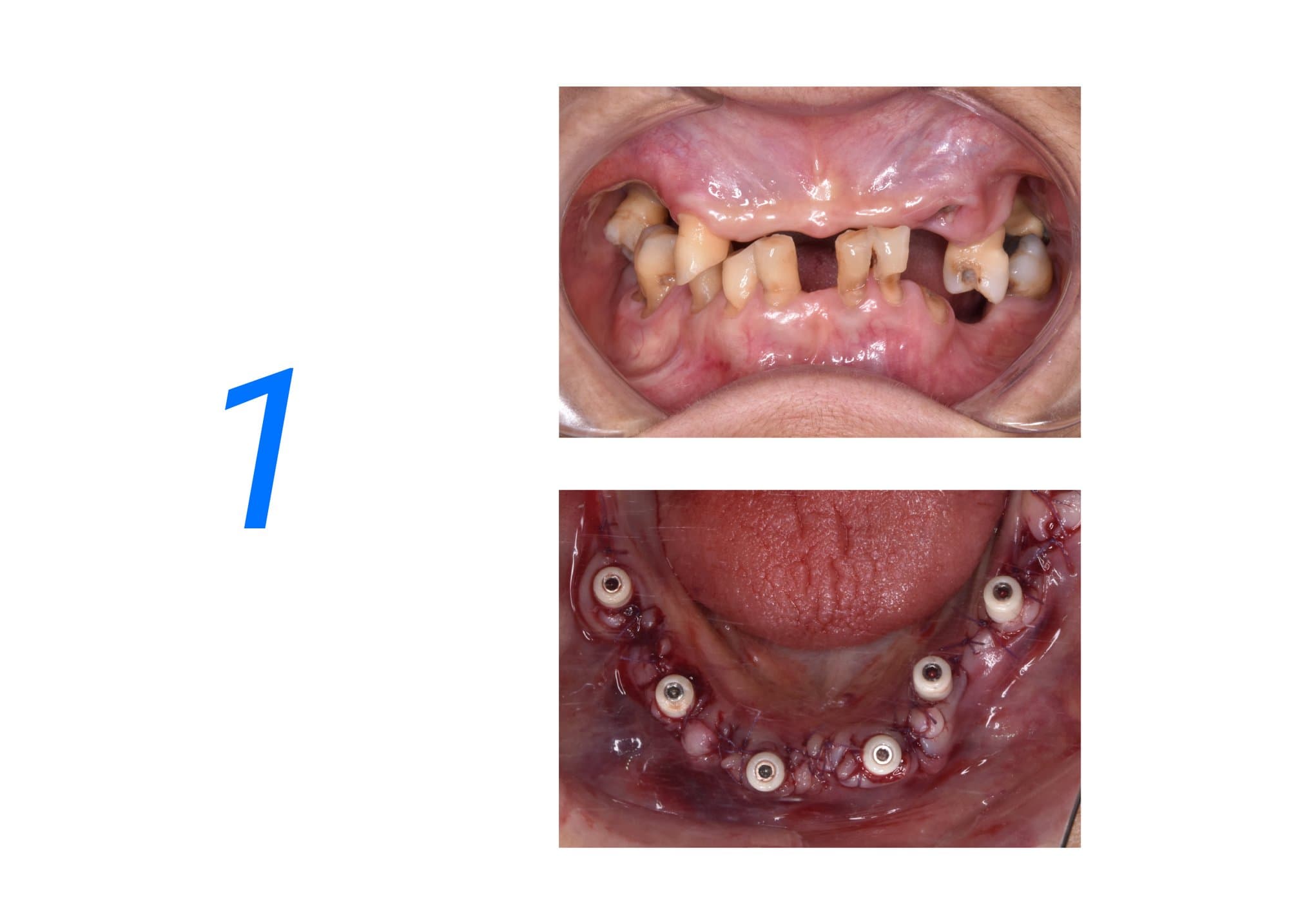
Why Digital Dentistry Is Not a Gimmick
Dentistry is changing. Not at some point in the future, but right now. What once meant multiple appointments, uncomfortable impressions, and days of waiting for dental restorations can now be completed in a single visit—more precise, faster, and significantly more comfortable for the patient.
The numbers tell this story clearly: The global digital dentistry market will grow from $8.05 billion in 2025 to $15.21 billion by 2031, a compound annual growth rate of 11.2 percent (Source: GlobeNewsWire, Digital Dentistry Market Analysis Report, 2026). In Germany alone, 84 percent of all all-ceramic restorations are already fabricated using computer-aided methods (Source: ZWP online, CAD/CAM Technology, 2024). Digital dentistry is no longer a trend—it's the established standard.
At Pul's Zahnmedizin, we're taking this a step further. We've designed our entire treatment workflow, from the initial scan to the finished crown, as a seamlessly integrated digital process. No analog breaks, no external labs for standard restorations, no unnecessary waiting times.
This article shows you what that means in practice.
The Scan: Aoralscan Elite
The first step in any digital treatment is capturing the oral situation. Years ago, this meant impression trays, impression material, holding still for several minutes, and often an uncomfortable gag reflex. Today, it looks completely different.
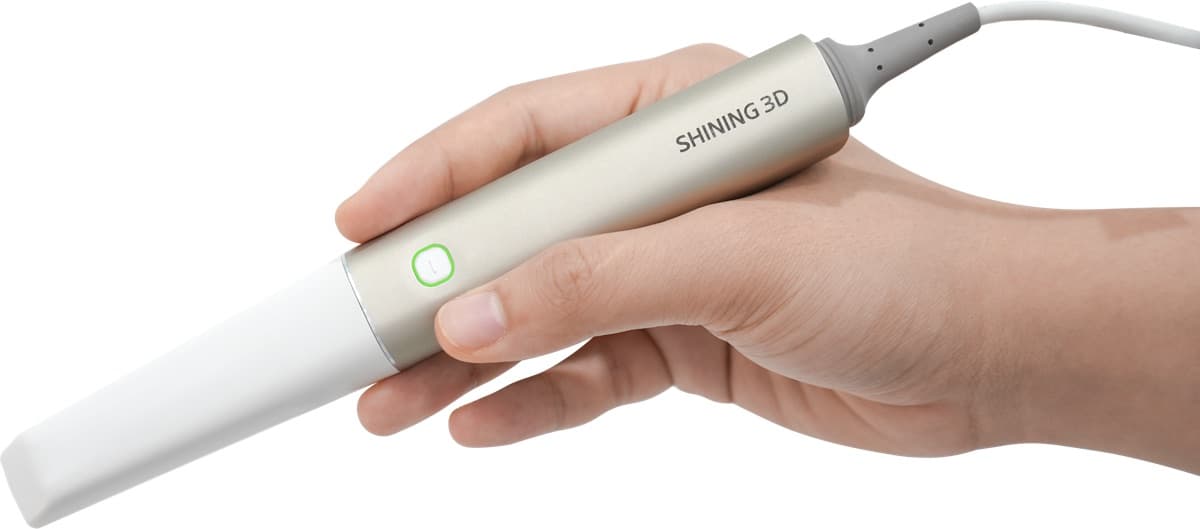
We use the Aoralscan Elite from Shining3D, the world's first intraoral scanner that combines intraoral scanning and photogrammetry in a single device. That sounds technical, but it has a very practical benefit: accuracy of 5 micrometers. That's roughly ten times more precise than conventional intraoral scanners and far surpasses even the best traditional impression techniques.
For comparison: a human hair is 50 to 70 micrometers in diameter. The Aoralscan Elite measures to one-tenth of that precision.
What This Means for You as a Patient
- No more impressions: Instead of impression material and gag reflex, your teeth are scanned with a small camera—completely contactless and in under a minute for your entire jaw.
- Instant results: The 3D model of your mouth appears in real-time on the screen. You see exactly what we see.
- Perfect fit: 5 micrometer accuracy means crowns, inlays, and veneers sit perfectly, with no need for adjustment or pressure points.
- Comfortable and fast: The scanner weighs only 124 grams and fits ergonomically in hand. The entire scan takes under a minute.
The German Society for Oral, Maxillofacial and Dental Medicine (DGZMK) confirms: Digital impressions, when handled correctly, show fewer errors and higher precision than conventional impression techniques with elastomers (Source: DGZMK / ZWP online, Scientific Assessment of Digital Impression). This isn't theoretical advantage—it's measurable quality.
The Analysis: E-Motion and CBCT with AI
A precise scan alone isn't enough. To plan treatment optimally, we need to understand how your jaws move, how your teeth relate to each other, and whether there are hidden findings that wouldn't be visible on a simple X-ray.
This is where two systems come in, working together to provide a complete picture.
E-Motion: Your Virtual Patient
The Shining3D E-Motion is an all-in-one platform that combines intraoral scanning with facial analysis and jaw movement measurement. The result is a dynamic virtual patient—a digital model that shows not just what your teeth look like, but how they move in everyday life.
- Jaw movement analysis: Sensors capture how your lower jaw moves when you chew, speak, and swallow. This data is crucial for designing restorations that not only fit, but function correctly.
- Occlusal contacts: The system analyzes where and how your teeth meet. Uneven pressure can lead to discomfort, temporomandibular joint problems, and premature wear.
- Facial analysis: For aesthetic treatments, the tooth model is placed in the context of your face, ensuring the result is not just functional but harmonious.
CBCT with AI-Assisted Diagnostics
For more complex cases—implant planning, wisdom tooth assessment, or clarification of unclear findings—we use Cone Beam Computed Tomography (CBCT). Unlike conventional X-rays, CBCT creates a three-dimensional image of your jaw with all its structures: bone, nerve canals, sinuses, and tooth roots.
The real innovation lies in AI-assisted analysis. A CBCT dataset consists of hundreds of individual slices. Analyzing each one individually is time-consuming and demands intense concentration. This is where artificial intelligence supports us:
- Automatic tooth segmentation: AI identifies and marks every individual tooth in the 3D dataset.
- Caries detection: Hidden cavities that are difficult to spot on conventional X-rays are reliably marked.
- Periapical lesions: Inflammations at tooth root tips are automatically detected, with studies showing sensitivity rates up to 92 percent for CBCT-based AI diagnostics (Source: Nature, Scientific Reports, 2024).
- Periodontitis analysis: Bone loss is quantified and visualized for precise severity assessment.
- 3D implant planning: AI calculates optimal implant positioning while considering all anatomical structures, enabling guided, minimally invasive surgery.
The key point: AI doesn't replace our judgment—it sharpens it. AI pattern recognition identifies anomalies across hundreds of slices, but the dentist always makes the final diagnosis and treatment decision. This isn't delegation to a machine; it's using modern technology to ensure nothing is overlooked.
AI sees what the eye might miss. The dentist always makes the decision.
The Design: Digital Smile Design
Once all data is available—intraoral scan, jaw movement analysis, and CBCT if needed—digital planning begins. Here you see the advantage of a seamlessly digital workflow: all data exists in one system and can be linked together.
From Dataset to Treatment Plan
Scan data from the Aoralscan Elite is transferred directly to design software. On screen, your new restoration design takes shape—whether it's a crown, inlay, veneer, or bridge. The jaw movement analysis data flows in, so the restoration not only fits geometrically, but is functionally correct.
What You Gain as a Patient
- Visibility: You can see the planned result on screen before treatment begins. No guessing, no surprises.
- Real-time corrections: If adjustments are needed, we can make them directly on the digital model without a new impression or extra appointment.
- Functional optimization: By integrating jaw movement data, your restoration is designed to feel natural when chewing and speaking.
- Seamless fabrication: The finished design goes directly to our 3D printers with no data transfer steps—no manual handoff, no room for error.
The Fabrication: SprintRay Pro 2 and Midas
This is where patients really notice the difference: instead of waiting for an external lab, we fabricate many restorations right in our practice. Two specialized 3D printers make this possible.
SprintRay Pro 2: Our Production Center
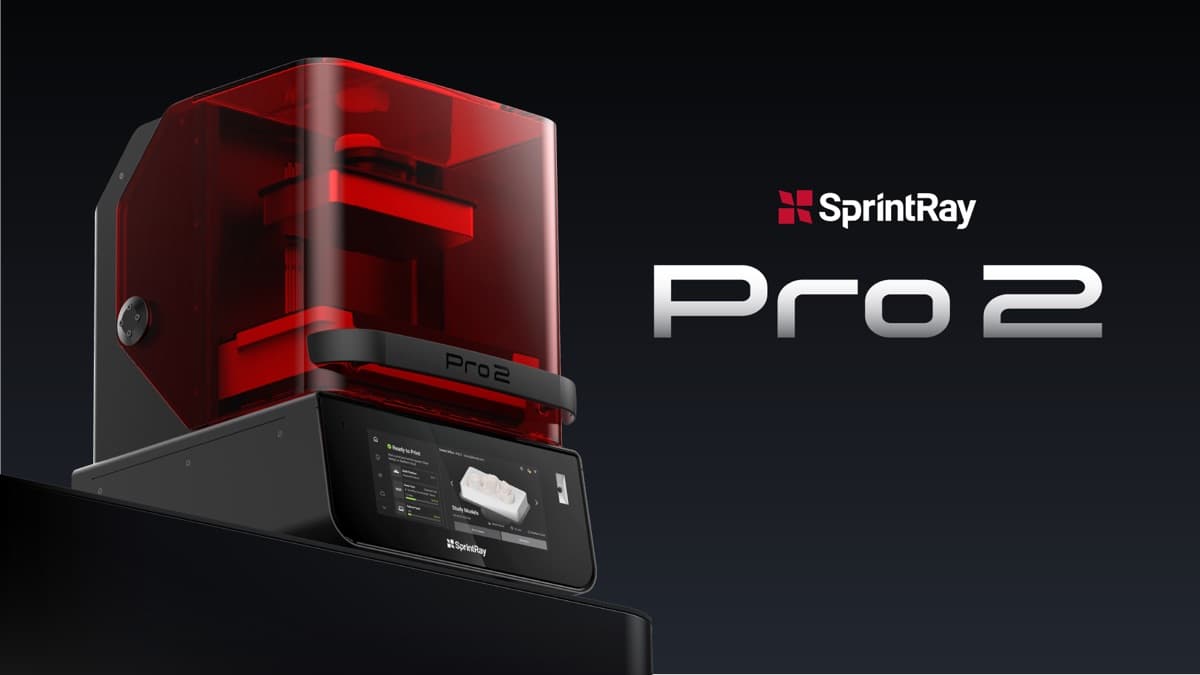
The SprintRay Pro 2 is our workhorse for in-office production. With XY resolution of 35 micrometers and accuracy of 23 micrometers, it produces dental models, aligner splints, night guards, dentures, and surgical guides in the highest quality.
The numbers are impressive: 6 complete jaw models in just 15 minutes. That means we can produce all models for an aligner therapy in a fraction of the time an external lab would need.
The Pro 2 handles over 15 different dental workflows, from clear aligner models to provisionals, dentures, and surgical guides. Cloud connectivity and a 12-inch touchscreen make operation straightforward.
SprintRay Midas: Chairside Restorations in Minutes
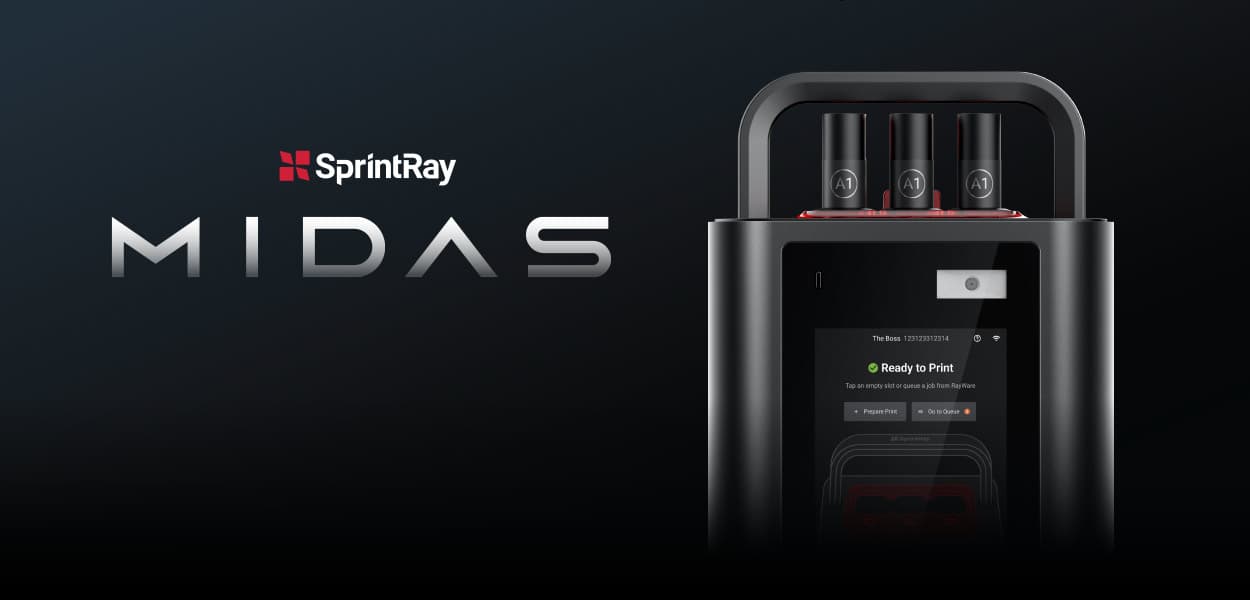
The SprintRay Midas is in a category of its own. While the Pro 2 is the practice's production center, the Midas sits right in the treatment area and delivers final restorations in record time.
The technology behind it is called Digital Press Stereolithography (DPS), a patented process that combines speed with precision:
- 3 crowns in under 10 minutes
- 6 inlays in under 10 minutes
- 9 veneers in under 10 minutes
The material comes in sealed resin capsules—no refilling, no spilling, no material waste. Three heated build platforms enable parallel production. Combined with the NanoCure post-processing unit, the entire fabrication process, from printer to finished, cured restoration, takes only minutes.
What This Means in Practice
Imagine this: You arrive with a damaged tooth. In one appointment, your tooth is scanned, the design is created, the crown is printed and placed. No provisional, no second appointment, no weeks of waiting. This isn't science fiction—it's our daily reality.
What This Means for You
The fully digital workflow isn't an end in itself. It solves concrete problems patients have faced for decades:
Fewer Appointments
A seamlessly digital workflow significantly reduces the number of appointments needed. Restorations that once required two or three visits over several weeks can often be completed in a single session with us. No provisional that falls out in the meantime. No repeat anesthesia at a second appointment. No work time lost.
Higher Precision
Each step in the analog chain—from impression to gypsum model to wax buildup—is a potential source of error. Every transfer can introduce inaccuracies. In our digital workflow, there are exactly zero manual transfers. Data flows directly from scanner to software to printer. The result: restorations that fit perfectly on first try.
More Comfort
No impression tray. No gag reflex. No waiting for the lab. Instead: a quick, contactless scan, a transparent digital plan you can see on screen, and a restoration that in many cases is finished the same day.
Transparency
You see every step of treatment, from scan through design to finished restoration. We explain what we're doing and why. Digital data can be shown, discussed, and optimized together—something impossible with a gypsum model gathering dust in a drawer.
Sustainable and Resource-Efficient
Digital workflows significantly reduce material consumption. No impression materials, no gypsum models, no unnecessary material transport between practice and lab. The sealed resin capsules of the Midas virtually eliminate material waste. This makes both economic and environmental sense for dentistry.
The Future Is Already Here
The numbers speak a clear language: the global intraoral scanner market will grow from $825.8 million in 2025 to $1.74 billion by 2032 (Source: Coherent Market Insights, Intraoral Scanners Market, 2025). Over 70 percent of dental practices in industrialized countries are already integrating digital workflows (Source: GlobeNewsWire, Digital Dentistry Market, 2026). In a few years, the question won't be whether a practice works digitally, but whether it can afford not to.
At Pul's Zahnmedizin, we're not waiting for the future. We've already planned it. Our fully digital workflow—from Aoralscan Elite through AI diagnostics to SprintRay Midas—is a core component of our practice plan for opening in 2027.
We're building a practice where technology serves patients. Join us on this journey.
Frequently Asked Questions (FAQ)
Is a digital impression as accurate as a conventional one?
It's significantly more accurate. Our Aoralscan Elite achieves 5 micrometer accuracy—roughly ten times more precise than conventional intraoral scanners and surpassing traditional elastomer impression techniques. The DGZMK confirms that digital impressions, when properly handled, have fewer errors than analog methods. For patients, this means better restoration fit, less rework, and a more comfortable process without impression material and gag reflex.
How reliable is AI diagnostics for CBCT analysis?
The AI modules we use for CBCT analysis achieve accuracy up to 95 percent for caries detection and sensitivity up to 92 percent for periapical lesions in scientific studies. Important: AI doesn't replace the dentist's diagnosis. It serves as an additional tool that marks anomalies across hundreds of slices, ensuring nothing is overlooked. The dentist always makes the final assessment and treatment decision.
Can everything really be done in one appointment?
For many standard restorations like crowns, inlays, and veneers, single-appointment treatment is possible. The SprintRay Midas prints up to three crowns in under ten minutes. Combined with intraoral scanning and digital design, we can complete the entire workflow—from scan through planning to finished restoration—in a single session. More complex cases, such as extensive bridges or implant restorations, still require multiple appointments, but even there the digital workflow significantly reduces overall treatment time.
What materials are used in 3D printing?
Our 3D printers work with materials specifically approved and certified for dentistry. The range extends from high-strength composites for final crowns and inlays to biocompatible resins for splints and guides to transparent materials for aligner models. All materials are CE-certified and approved for permanent oral use. The sealed capsules of the SprintRay Midas also ensure consistent material quality without contamination risk.
What does a digitally fabricated restoration cost compared to others?
Costs for digitally fabricated restorations are comparable to those from external labs, with significantly shorter treatment time and better fit. Since we fabricate many restorations in-office, lab turnaround times and extra appointments are eliminated. This often saves not only time but also the cost of a provisional. We discuss exact costs before every treatment, transparently and individually, including a written treatment and cost plan.